
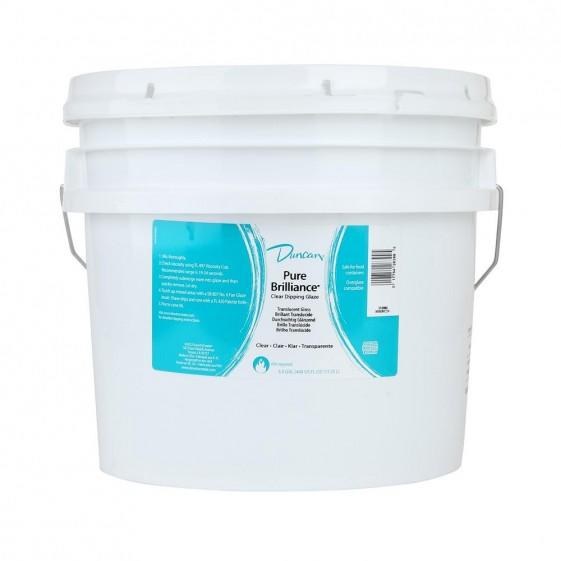
PBD001 - Pure Brilliance, Clear Glaze, Cone 06, 3 gall.
Item#: 3PBD001
Description: Use Duncan Clear Glaze to apply a sparkling protective finish to ware.
CONE 06 OXIDATION:
- Clean, clear surface and gloss finish. Luster compatible.
CONE 6 OXIDATION:
- No color change – blistering/pinholing can occur.
PBDIP - Pure Brilliance Dipping
•Functionally, clear glaze forms an impervious barrier that protects against liquids, dirt, and abrasion.
•Aesthetically, our clear glazes provide a gloss finish over top of your colored glaze decoration.
•Dipping glazes differ from brushing versions as they contain fewer organic additives, making the dipping glazes less viscous than brushing formulas.
•Dipping glazes allow for quick and efficient glazing on large pieces or a large number of pieces.
•The amount of glaze deposited on bisque is primarily a function of glaze viscosity and the amount of time the bisque is left in the glaze – careful attention to these two details are critical to obtaining satisfactory results.
General Use
Container should be kept tightly closed when not in use. Store in a cool, dry place away from heat and vibration.
♦
Mixing with a power mixer is required prior to first use (hardware/paint stores offer many drill mounted mixer attachments). Mix for 7-8 minutes. Using a viscosity cup, check viscosity. Our recommended viscosity ranges are: Dupont m50, 19-24 seconds; VC100, 10-12 seconds; 47399 Stainless Steel, 23-35 seconds. If glaze is too thin, remix for an additional 2-3 minutes and re-measure the viscosity. If too thick, add distilled water in 1/2 cup increments. Remix and retest. For best dipping results and operational efficiency use of a dipping container 24” to 30” deep, holding 15 to 30 gallons of glaze.
♦
Color glazes applied to bisque ware should be thoroughly dry before dipping. Do not force dry color glazes by using heated air sources (hair dryer, heat lamp) as doing so may affect the performance of both the color and clear glazes.
♦
• The use of protective equipment, such as an apron or smock, rubber gloves, safety glasses or similar eyewear and shoe coverings is recommended. DO NOT spray apply without proper personal protective equipment.
• Using dipping tongs (or by hand, wearing latex or rubber gloves), fully immerse the entire piece using a smooth in-and-out motion. The duration of the dip should not exceed 1 -1 . seconds. Dip only once! Remove the bisque from the dipping glaze rotate 90 degrees and immediately shake vigorously 2-3 times, rotating the piece as you shake, to minimize drips and runs. Use a soft fan brush (RB140) moistened in the dipping glaze to pat away drips and runs and to touch up the area where the bisque was held.
• The amount of clear glaze deposited on the ware can involve many variables, such as bisque porosity, glaze viscosity, and your dipping mechanics. Fired results can be impacted by the amount of color glaze, firing time and temperature. As you gain dipping experience you will learn how to make adjustments for these variables and improve your fired results.
• NEVER finger sand to remove drips or imperfections. Sanding can create dust, which can be harmful if inhaled.
• While dipping, re-stir the glaze as needed (15-20 minutes) to keep it fully dispersed. Measure the viscosity each time you mix.
• Clean up any spills with a damp mop or sponge to minimize the creation of harmful dust.
• Allow glaze to dry thoroughly before firing. Recommended firing is shelf cone 06. In some instances glaze clarity may be improved by firing to shelf cone 05.
• We recommend the use of a dipping log that tracks production lot numbers in the event of technical issues.
What is a clear glaze?
Clear glazes are glass coatings used to completely seal the ware (decorated or undecorated, making the ware impervious to liquids. They are also used to boost the brilliance of the underlying color. Clear glazes can come in different finishes such as gloss (NT-BR, S2101) or matte (C-300).
Should I use a dipping or brushing clear glaze?
* Choosing a dipping or brushing version of a clear glaze is dependent on application preference, quantity of glazing and time. Mayco offers pre-made low fire clear glaze in both dipping and brushing formulas.
* Brushing clear glazes differ from dipping versions in that they contain organic additives, which make the brushing glazes thicker (viscous) than dipping formulas. These additives are meant to improve the flow of glaze from the brush and assist with the even-ness of application, enhancing the fired surface finish.
* The amount of glaze deposited on the ware is primarily a function of glaze viscosity and the number of applications. Typically, 2 applications are required, allowing dry time between coats. Dipping clear glazes contain fewer organic additives, making dipping glazes less viscous than their brushing counterpart.
* The amount of glaze deposited on the ware is a function of glaze viscosity and the amount of time left in the glaze. Often dipping glazes are preferred in a studio or production environment where a large quantity of ware is processed.
What does coefficient of expansion (COE) mean and how does it impact my choices of
glazes,clay or bisque?
* Glaze and clay/bisque bodies are both ceramic materials. During the firing process they expand and then contract together; the rate of expansion/contraction can be measured and mathematically stated as a coefficient of expansion.
* Glaze and clay/bisque bodies are both ceramic materials. During the firing process they expand and then contract together; the rate of expansion/contraction can be measured and mathematically stated as a coefficient of expansion. If the two materials are not compatible – if they expand or contract at widely varying rates – the glaze may crack or chip off the body (please understand that incompatible COE’s are only one cause for glazes to chip or crack).
* Mayco strives to produce glazes that are as tolerant of as many major sources of earthenware and stoneware bodies as is feasible. We stock over 20 types of clay bodies for testing purposes and glaze and fire samples from every shipment of bisque. But there are hundreds of clay bodies in use around the world, with hundreds of color glaze and clear glaze combinations being used on these bodies.
* With respect to clear glaze: if you are experiencing an inordinate amount of shivering – glaze chipping off the body– you may want to try S-2000.
If you are experiencing crazing – glaze in which cracks appear – you may want to try NT-CLR.
Occasionally I find hard, white pellets in my clear glaze. What are they?
Oolites are little pebbles of calcium carbonate. They form naturally although the exact reasons for their formation are unclear. With respect
to clear glaze their occurrence is usually during the late summer months – the combination of the warm temperatures and vibration the glaze may
experience during transit may factors. These materials can be strained out of the glaze using a fine mesh sieve.
The C-300 fired with a milky finish, what happened?
If the application of glaze is too heavy the C-300 will fire to a hazy/milky finish. We recommend 2 even coats.
Are the brush on clear glazes luster compatible?
Yes, it takes on the finish of the clear glaze i.e. if applied to a gloss glaze it will be glossy, if applied with a matte glaze it will be matte.
C-300 did not fire matte. What happened?
Use witness cones to verify the kiln is firing to the correct temperature. This is the only way to verify the internal kiln temperature.
Can the brush on glaze be fired to cone 6?
It was formulated for a cone 06/05 firing. Mayco recommends the Stoneware line of clear glazes for higher temperatures.
I used S-2101 over the top of a red clay and it fired to a milky purple/bluish finish, why?
Mayco’s quality control with clear glazes are on white clay bodies. Iron Oxide reacts with clear glazes causing the tint.
Do you have any use suggestion for Duncan Pure Brilliance?
* Due to differences in our manufacturing process, customers will notice a difference in the viscosity of Duncan dipping glazes. Mayco advises that you retest for the proper amount of water to add to achieve your desired viscosity. The fired finish will match the Duncan manufactured standard. If you have questions, please contact Mayco’s technical support team: (614) 675-2031 /technical@maycocolors.com
* When you receive Pure Brilliance Clear Dipping Glazes in a 1-gallon or 3.5-gallon container you will notice very minimal settling, which is uncharacteristic of clear dipping glaze formulas. The glaze will arrive in a gel-like state and appear thicker than dipping glazes of the past. This gel formula is intentional and is by design. The gel-like state helps to keep the glaze in suspension during shipment, making it easier for you to mix in preparation of use.
* The viscosity range for Pure Brilliance Clear Dipping Glaze is 19-24. Please use this range as a guideline. Your personal number may vary. We strongly encourage you to try the glaze in a thicker state during your initial use than you may have become accustomed to with other dipping glazes. Due to the new technology used to develop this glaze it will perform very well when it appears thicker than glazes of the past.
* Less water in the glaze will eliminate overlap lines, keep black detail lines looking much sharper with no bleeding, and improve overall drying time.
* Pure Brilliance Clear Dipping Glaze has been formulated to not over accumulate on pieces making over-application issues almost non-existent. Application results can now be consistent from person to person with varying dipping techniques using the same dipping tank of glaze.
* Pure Brilliance Clear Dipping Glaze has an extended “open” time immediately after dipping to allow you to shake off drips and runs, but has an overall faster drying time helping you and your staff get the kilns loaded quickly with less work.
* Pure Brilliance Clear Dipping Glaze dries to a manageable but stable state allowing you to load kilns without the glaze flaking off in your hands. No more glazed starved plate rims! Stable drying also means no dust and mess in your studio!
Share:
Share on Facebook Share on Twitter Share on Pinterest Tell a friend