
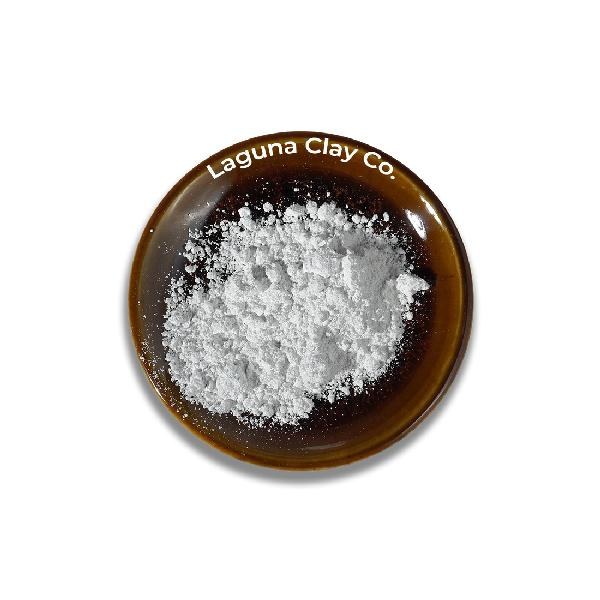
Titanium Dioxide
| Qty: | Unit Price per LB: |
|---|---|
| 5 | $9.99 |
| 10 | $8.88 |
| 55 | $6.66 |
| 110 | $5.55 |
Item#: 11231701
MPN: MTIDIOX
Alternate Names: TiO2
Description: Anatase, Brookite
- Full bag is 55 lbs
- Insoluble in water.
- Important opacifier.
- Often used in glaze to affect acid resistance, color and texture.
- Titanium is the strongest white pigment known for many uses, in ceramics the whiteness (and opacity) it imparts to glazes is due to its tendency to crystallize during cooling. While titanium dioxide is used in glazes as an opacifier, it is not as effective and easy to use as tin oxide or zircon.
TiO2 occurs in many silicates in nature, accounting for over 1% of the earth's crust. Thus it is manufactured using a variety of materials and processes. Titanium dioxide power is very fine-grained and it agglomerates, so glazes containing it need to be sieved to break down the small lumps (even a high-speed propeller mixer often won't do it).
Although titanium is the strongest white pigment known for many uses, in ceramics the whiteness (and opacity) it imparts to glazes is due to its tendency to crystallize during cooling. While titanium dioxide is used in glazes as an opacifier, it is not as effective and easy to use as tin oxide or zircon. It can be used as an additive to enliven (variegate, crystallize) the color and texture of glazes by introducing crystallization. Rutile works in a similar manner, typically both become saturated in the melt beyond about 5-6%, producing a dry and unstable glaze surface. In moderate amounts, it encourages strong melts, durable surfaces and rich visual textures.
Titanium is available both as raw and surface-treated products. Non-pigmentary grades flow more freely in the dry state. Self-opacified enamels are made by adding titanium during smelting to supersaturation. Upon firing the enamel, the titanium crystallizes or precipitates to produce the opacity. Titania is also used in dry process enameling on cast iron appliances for its effect on acid resistance, color and texture. In glass, non-pigmentary titanium dioxide increases the refractive index and intensifies color.
Share:
Share on Facebook Share on Twitter Share on Pinterest Tell a friend